
Licensed and Insured Movers: How to Verify a USDOT Number

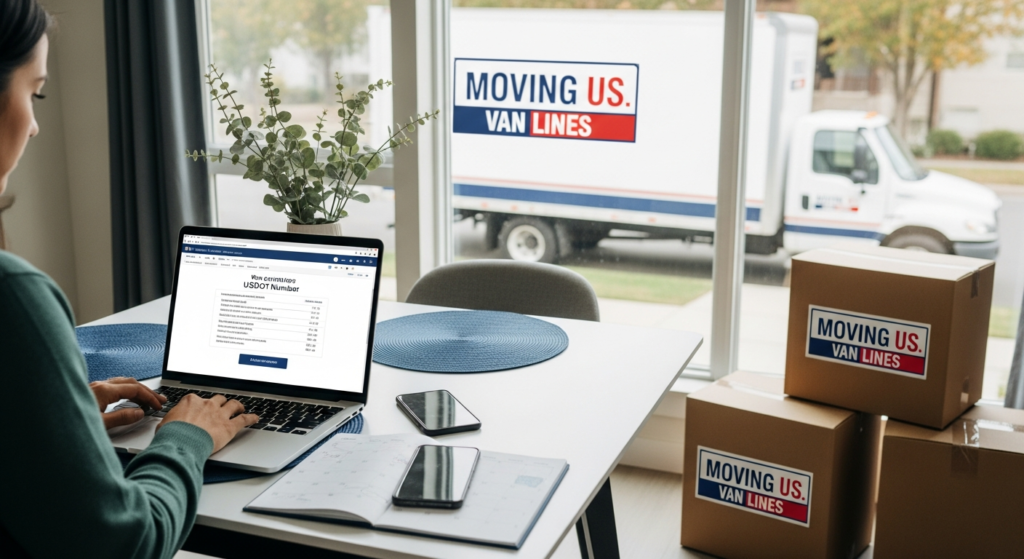
When you are getting ready to move, choosing licensed and insured movers is one of the most important decisions you will make. The wrong choice can turn moving day into a stressful, expensive problem. The right choice means your belongings are handled by professionals who follow the rules, carry proper insurance, and are accountable if something goes wrong.
For most interstate moves, the fastest way to protect yourself is to verify the moving company\’s USDOT number and make sure the mover is properly registered and insured. Unfortunately, many people skip this step, rely only on online reviews, and only discover problems after a truck is already loaded.
This guide explains, in plain language, what a USDOT number is, how it relates to licensed and insured movers, and how to verify a moving company before you sign a contract or pay a deposit. You will also learn how to compare movers, interpret different types of estimates, and use a marketplace like Moving US Van Lines to review multiple options side by side.
Use this article as a practical checklist: follow the steps, ask the right questions, and you will be in a much stronger position when you choose a mover.
Key takeaways
- Any mover that transports household goods across state lines must have a valid USDOT number; verifying it helps confirm you are working with a properly registered carrier or broker.
- Do not rely only on a website logo or the words \»licensed and insured movers.\» Always confirm registration, operating status, and insurance details before paying a deposit.
- Gather the company\’s exact legal name, any \»doing business as\» names, phone numbers, and addresses before you perform a mover lookup.
- Comparing at least three verified movers and reviewing written estimates side by side is one of the best ways to avoid overpaying or getting caught in a bait-and-switch.
- Move distance, shipment weight or size, dates, packing, access challenges, and extra services all affect your final moving cost.
- Use a moving marketplace like Moving US Van Lines to save time by submitting your move details once and comparing licensed movers that match your needs.
- Keep critical items with you on moving day, including IDs, medications, essential documents, and a small toolkit, even when you trust your mover.
Why the USDOT number matters for licensed and insured movers
When you hear the phrase \»licensed and insured movers,\» you might assume it means the company is heavily regulated and fully protected. In reality, those words are sometimes used loosely in marketing. Verifying a mover\’s USDOT number is one of the clearest ways to confirm whether a company is truly registered to operate interstate and what kind of insurance or authority it has.
For interstate household moves, most movers must be registered with federal transportation authorities and carry a USDOT number. That registration is tied to safety records, complaint histories, and basic insurance and operating status information. A fake or inactive USDOT number is a serious warning sign.
Verifying a USDOT number matters because it helps you:
- Confirm the mover is a real business with a traceable safety and compliance history.
- See if the company is a motor carrier, broker, or both, so you understand who will actually transport your belongings.
- Check whether the mover is currently authorized to operate or has been put out of service.
- Spot inconsistencies between the name on the truck, the website, and the legal name on file.
When you combine USDOT verification with smart quote comparison, you are much more likely to choose licensed and insured movers that fit your expectations on price, timing, and service level.
What a USDOT number is and when movers need one
A USDOT number is a unique identifier issued to certain commercial motor carriers that operate in the United States. It is used to track safety information, inspections, crashes, and compliance reviews.
For moving customers, the most important points are:
- Most movers that transport household goods across state lines must have a USDOT number.
- Some states also require USDOT numbers for in-state moves, depending on vehicle size and type of operation.
- Local-only movers in some areas may not have a USDOT number but should still hold required state or local licenses.
Carrier vs. broker: why it matters
When you verify a USDOT number, you will generally see whether a company is a motor carrier, a broker, or both.
- Motor carrier: A company that owns or operates the trucks that actually move your belongings.
- Broker: A company that arranges transportation and contracts with other carriers to perform the move.
Neither option is automatically better, but you should know which you are dealing with. If you book through a broker, you will want to know which carrier is assigned to the job and verify that carrier as well.
Common move types and USDOT needs
| Move scenario | USDOT typically required? | What you should verify |
|---|---|---|
| Apartment move from one state to another | Yes, for the interstate carrier | USDOT number, operating status, insurance level, complaint history |
| Single-family home move within the same state, long distance | Depends on state rules and truck size | State moving license, local permits; USDOT if applicable |
| Office move across state lines | Usually yes for the carrier | USDOT, commercial moving experience, insurance coverage |
Regardless of whether a USDOT number is technically required in your situation, treating verification as a standard step helps you filter out unprofessional operators.
What to gather before you verify a moving company
To verify a US moving company efficiently, organize a few basic details before you start doing any mover lookup. This will help you avoid confusion when multiple companies have similar names.
Information checklist
- Full legal company name (from the estimate or contract draft)
- Any \»doing business as\» or brand names
- Phone numbers and email addresses used for quotes
- Physical business address listed on the website or estimate
- USDOT number and MC (motor carrier) number, if the company already provided them
- Names of any sales reps or coordinators you\’ve spoken with
If the company refuses to provide a USDOT number for an interstate move, treat that as a major red flag.
Sample wording you can use:
\»Before I book, I need to verify your registration. Can you please email me your USDOT number, MC number, and the exact legal name you operate under for interstate moves?\»
Collecting this information also makes it easier to compare moving companies later. When you work with a platform like Moving US Van Lines, you submit your details once and receive quotes from multiple licensed movers, each with clear contact and company information you can verify.
Step-by-step: how to verify a mover\’s USDOT number
Verification is not complicated, but it is worth doing carefully. The exact online tools you use may change over time, yet the core steps stay the same.
1. Start with the information the mover gives you
- Ask for the company\’s USDOT and MC numbers in writing (email or quote form).
- Confirm the spelling of the legal company name and any DBA names.
- Note down the business address, phone, and website domain.
Compare the information in the email or estimate to what appears on the company\’s website. Mismatched business names or addresses are worth a closer look.
2. Look up the USDOT number
Next, perform an FMCSA-style mover lookup by USDOT number or company name. When reviewing the results, pay attention to details such as:
- Exact legal name and any trade names
- USDOT number status (active, inactive, out of service)
- Whether the company is listed as a carrier, broker, or both
- Basic insurance information and coverage type
- Company address and contact information
Make sure this information matches what the mover provided. If the mover\’s website shows a different company name than the official record, ask for an explanation.
3. Verify operating status and insurance
Confirm that the mover is currently authorized for the type of operation you need (for example, interstate household goods). Check that insurance information appears current and appropriate. Look for:
- Authorization to operate for-hire, if relevant to your move
- Household goods authority (not just general freight)
- Liability insurance and cargo insurance information
Remember that household goods movers typically provide valuation coverage options in your estimate and bill of lading. That coverage is not always the same as a full insurance policy, so read the fine print carefully.
4. Cross-check by company name and location
If you find several companies with similar names, use the address and phone numbers you collected earlier to match the right record. Be cautious of movers that share a very similar name and city with multiple USDOT records, or a company that frequently rebrands under new names.
5. Document what you find
Create a simple comparison sheet where you record the verification details for each moving company you are considering. This will help you choose between licensed and insured movers based not just on price but on transparency and track record.
| Mover | USDOT & status | Notes from verification |
|---|---|---|
| Mover A | Active, carrier & household goods authority | Name & address match estimate; current insurance on file |
| Mover B | Active, broker only | Broker arranges carrier; requested carrier details before booking |
| Mover C | Inactive; not authorized | Did not proceed; status inconsistent with sales claims |
Understanding \»licensed and insured movers\» claims
The phrase \»licensed and insured movers\» appears on many websites and trucks, but it can mean different things depending on the company and the type of move. Understanding how licensing and insurance work will help you interpret what a mover is really offering.
Licensing basics
For interstate moves, licensing usually refers to federal registration and operating authority for household goods transportation. For local and intrastate moves, licensing is often handled at the state or even local level. Requirements can include:
- State-issued household goods moving licenses
- City or county business permits
- Registration of trade names or DBAs
- Compliance with tariff and estimate rules
Always ask which licenses apply to your specific move and what authorities the company holds. A mover could be fully licensed for local moves but not authorized for interstate transportation.
Insurance and valuation coverage
When movers say they are insured, they may be referring to several different types of coverage:
- Liability insurance: Protects against certain types of damage or injury related to operations.
- Cargo or transit coverage: Applies to the goods being transported, subject to limits and exclusions.
- Valuation options: Contractual protection for your belongings, such as released value or full-value protection, described in your estimate and bill of lading.
Insurance and valuation are not the same. Insurance is a policy the company carries; valuation is the level of protection you choose for your shipment. Ask for written explanations of both.
Sample question you can ask:
\»Can you walk me through the valuation options on my estimate and explain what your insurance does and does not cover for my move?\»
Red flags when checking a mover\’s USDOT and insurance
Verifying a USDOT number is not just about checking that something exists; it is about spotting warning signs before you commit. When you verify a moving company, pay special attention to the following issues.
Common red flags
- Company refuses to provide a USDOT number for an interstate move.
- USDOT number belongs to a different company name than the one contacting you.
- Operating status shows inactive, out of service, or revoked authority.
- Website and paperwork use multiple inconsistent business names.
- Sales pressure to pay a large cash deposit before verification.
- No clear business address or only a mailbox location.
Matching red flags to protective steps
| Red flag | Why it matters | Protective step |
|---|---|---|
| Refusal to provide USDOT number | Suggests the company may not be properly registered | Do not book; look for another mover that is transparent |
| Inconsistent business names | Could indicate frequent rebranding or attempts to avoid complaints | Ask for explanation; verify all names; consider other movers |
| Out-of-service or inactive status | Mover is not authorized to operate as described | Do not proceed; choose a mover with active status |
Checking for these red flags early allows you to remove risky movers from your list and focus on licensed and insured movers with consistent, verifiable records.
How to compare moving estimates from verified movers
Once you have confirmed that potential movers are properly registered and insured, the next step is to compare estimates. This is where platforms like Moving US Van Lines can save you time by helping you review quotes from multiple licensed movers side by side.
Types of moving estimates
Understanding estimate types is essential when you compare moving companies.
- Non-binding estimate: The price can change based on actual weight or services provided. You pay for what is actually shipped, but the final cost may be higher than expected.
- Binding estimate: The price is set based on the inventory and services listed. If nothing changes, the amount should not increase, but added items or services can result in new charges.
- Binding-not-to-exceed estimate: You pay the lower of the estimated price or the actual cost. If the actual weight is less than estimated, you may pay less.
Comparing estimates side by side
When you receive multiple quotes from verified movers, use a simple comparison table to understand your options.
| Mover | Estimate type | Key inclusions |
|---|---|---|
| Mover A | Binding-not-to-exceed | Loading, transport, basic packing of fragile items, fuel |
| Mover B | Non-binding | Loading and transport only; no packing or materials |
| Mover C | Binding | Full packing, loading, transport, unpacking, debris removal |
Do not focus only on the bottom-line price. Consider what is included, what is excluded, and how the estimate type affects your risk if conditions change.
Checklist for comparing estimates
- Verify that the company name and address match what you saw when you verified the USDOT number.
- Confirm the estimate type (binding, non-binding, or binding-not-to-exceed).
- Review the inventory list or estimated weight used to create the quote.
- Check which services are included: packing, unpacking, assembly, storage, etc.
- Look for access-related fees: long carries, stairs, elevator, or shuttle service.
- Ask how changes in your shipment or dates will affect the price.
Using a quote comparison marketplace like Moving US Van Lines makes this process easier because you can submit your information once and see multiple estimates laid out for direct comparison.
Key cost factors that affect moving quotes
Even among licensed and insured movers with similar USDOT profiles, pricing can vary widely. Understanding the most important cost drivers helps you interpret quotes and control your budget.
Core cost drivers
- Distance: The farther your move, the higher the transportation and fuel costs.
- Weight or volume: More belongings mean larger or heavier loads, which usually cost more.
- Timing: Moving during peak season, weekends, or end of the month can carry higher rates.
- Access: Stairs, long carries, limited parking, and narrow streets can add labor and time.
- Services: Full packing, unpacking, crating, and specialty handling all affect cost.
- Storage: Short- or long-term storage between pickup and delivery adds fees.
Sample cost factor overview
| Cost factor | How it affects price | Ways to manage it |
|---|---|---|
| Move date flexibility | Peak dates often cost more due to higher demand | Ask movers about midweek, mid-month, or off-peak dates |
| Amount of stuff | Heavier or bulkier shipments increase line-haul and labor | Declutter and donate items you do not need before moving |
| Packing services | Professional packing adds labor and materials costs | Pack some or all boxes yourself if you have the time |
When you request moving quotes, be as accurate as possible about your inventory and access conditions. That helps licensed and insured movers provide realistic estimates with fewer surprises on moving day.
How to choose the right mover type for your situation
Not all moves are the same, and not all licensed and insured movers focus on the same services. Selecting the right mover type for your situation can improve your experience and sometimes reduce costs.
Common mover categories
- Local movers: Typically handle moves within a certain radius or metro area.
- Interstate and long-distance movers: Specialize in moves across state lines and cross-country relocations.
- Commercial movers: Focus on office and business relocations, including specialized equipment.
- Residential movers: Concentrate on homes and apartments, with varying service levels.
- Packing and specialty movers: Provide professional packing, crating, and handling of fragile, bulky, or high-value items.
Matching mover type to your needs
| Your situation | Mover type to consider | Key priorities |
|---|---|---|
| Short move within the same city | Best local movers | Hourly rates, crew size, access to buildings, local reputation |
| Interstate move to another state | Best interstate movers | USDOT verification, delivery windows, valuation options |
| Office relocation with equipment | Best commercial movers | Business downtime, equipment handling, building requirements |
| Need full packing service | Best packing and moving companies | Packing quality, materials, labeling, unpacking options |
Platforms like Moving US Van Lines help you compare movers by move type so you can narrow your search to companies that handle your specific kind of relocation.
Questions to ask before booking a mover
Even after you verify a mover\’s USDOT number and compare estimates, you should ask a few final questions before you sign an agreement or pay a deposit.
Key questions checklist
- Can you confirm your USDOT and MC numbers and your exact legal company name?
- Are you the carrier performing the move, or will you broker it to another company?
- Will my shipment be on a dedicated truck or combined with others?
- What estimate type is this, and under what conditions can the price change?
- What valuation options are available, and what are the deductibles or limits?
- What is your standard delivery window for my route and time of year?
- How do you handle elevators, parking permits, and building move requirements?
- What is your policy for delays, damage claims, and cancellations?
Sample wording for a clarification email:
\»Thank you for the estimate. Before I confirm, can you please clarify whether this is a binding or non-binding estimate, and list any additional fees that might apply for long carries, stairs, or shuttles at either location?\»
Licensed and insured movers that value their reputation should be willing to answer these questions clearly, in writing.
What to keep with you on moving day
Even when you have carefully verified your mover\’s USDOT number and chosen a reputable company, there are some items you should always keep with you rather than loading on the truck. This protects you in case of delays, route changes, or unexpected issues.
Must-keep items
- Personal identification: driver\’s licenses, passports, and any necessary visas.
- Financial items: checkbook, credit/debit cards, and a small amount of cash.
- Important documents: leases, closing papers, insurance policies, medical records, and school records.
- Medications and essentials: prescriptions, glasses, and daily-use items.
- Valuables: jewelry, small electronics, collectibles, and irreplaceable items.
- Moving paperwork: estimates, confirmation emails, inventory sheets, and bills of lading.
- Basic tools and supplies: box cutter, tape, a few trash bags, and cleaning supplies.
Packing a small \»first 48 hours\» box or suitcase with clothes, toiletries, linens, and essentials can make your first nights in the new place more comfortable, even if the truck is delayed.
How Moving US Van Lines helps you compare licensed movers
Manually verifying every mover, requesting quotes separately, and comparing estimates line by line can be time-consuming. Moving US Van Lines is designed to simplify that process while keeping you in control of your decision.
Through the Moving US Van Lines platform, you can share your move details once and receive quotes from multiple licensed and insured movers that match your route, timing, and service needs. You can then compare pricing, availability, and services side by side before you choose who to contact or book.
Instead of relying on a single salesperson\’s pitch, you can:
- Review offers from different movers that serve your route.
- Check each company\’s legal name and USDOT number for verification.
- Compare included services, estimate types, and delivery windows.
- Decide which movers fit your budget and expectations.
Helpful Moving US Van Lines resources
Using these resources, you can quickly narrow down your options to movers that are a good fit, and then complete your own USDOT verification and estimate comparison process.
Frequently asked questions
Do all movers need a USDOT number?
Not all movers need a USDOT number, but most companies that transport household goods across state lines do. Some states also require USDOT numbers for certain in-state operations, depending on vehicle size and type of service. Always ask your mover whether they need and have a USDOT number for your specific move.
How can I verify that a mover is licensed and insured?
Start by asking for the mover\’s USDOT and MC numbers, legal company name, and address. Perform a mover lookup using the USDOT number to confirm operating status, authority type, and basic insurance information. Then review your written estimate and service agreement for details about valuation coverage and any additional insurance options.
What if the company name on the USDOT record does not match the website?
If the legal name on the USDOT record differs from the name used in marketing, ask the company to explain the relationship. Many companies use trade names or DBAs, but they should be able to show that their brand name and legal entity are connected. If they cannot provide a clear explanation, consider choosing another mover.
Is an online review enough to trust a moving company?
Online reviews can be helpful, but they should never replace basic verification steps. A professional mover should have verifiable registration, clear contact information, and written estimates. Use reviews as one piece of your decision, along with USDOT verification, license checks, and detailed quote comparison.
What should I do if a mover refuses to provide a USDOT number?
For interstate moves, a refusal to provide a USDOT number is a major red flag. Politely explain that you cannot proceed without verifying their registration. If they still will not share their information, it is safer to move on and request quotes from other licensed and insured movers.
How many moving quotes should I get?
It is usually wise to get at least three written estimates from verified movers. This gives you a reasonable range of pricing and service options to compare without becoming overwhelming. Using a marketplace like Moving US Van Lines can make it easier to gather and compare multiple quotes efficiently.
Can I save money by packing myself?
Packing yourself can reduce costs, especially if you gather free or low-cost supplies. However, self-packing requires time and effort, and may affect certain valuation options. Ask movers how self-packing impacts protection and whether there are specific items they must pack themselves, such as large fragile pieces.
What is the difference between a carrier and a broker in moving?
A carrier owns or operates the trucks that physically move your belongings. A broker arranges transportation and contracts with carriers to perform the move. Some companies are both. When you book, ask whether you are hiring a carrier or a broker and, if it is a broker, which carrier will handle your move so you can verify that company as well.
When should I start verifying movers and getting quotes?
For interstate or large household moves, starting 6 to 8 weeks before your desired move date is often ideal. In busy summer months, earlier is better. Starting early gives you time to verify USDOT numbers, compare estimates, and secure your preferred dates, especially if you have specific timing needs.
Can Moving US Van Lines verify movers for me?
Moving US Van Lines is a quote comparison platform that focuses on helping you connect with licensed and insured movers and compare your options. You are still encouraged to perform your own verification using the information movers provide. The platform can save you time by allowing you to request moving quotes once and then review offers from multiple movers.
Sources referenced in this guide
To create this guide, we relied on commonly referenced materials and standard practices in the moving industry, including:
- Federal Motor Carrier Safety Administration consumer guidance for interstate household goods moves and mover registration.
- U.S. Department of Transportation moving guidance on carrier safety, compliance, and USDOT number requirements.
- State transportation and consumer protection agency information on intrastate moving licenses and consumer rights.
- Standard written moving estimates, bills of lading, and carrier tariffs used by professional household goods movers.
- Building management move-in and move-out rules, including certificate of insurance requirements and elevator reservations.
This guide is general moving information, not legal, insurance, or regulatory advice. Moving requirements, pricing, access rules, availability, and coverage options may vary by location, move type, mover, building rules, and service agreement.
When you are ready to move forward, you can use Moving US Van Lines to compare licensed movers, request moving quotes, and review top moving company guides so you can choose the right partner for your relocation with confidence.
Lead moving analyst covering long-distance carriers and interstate pricing.
More from the blog
Compare movers by service
Where to find us
Compare quotes from licensed movers
Submit your move details once and receive custom quotes — all at no cost.