
How to Move Furniture Up and Down Stairs Safely

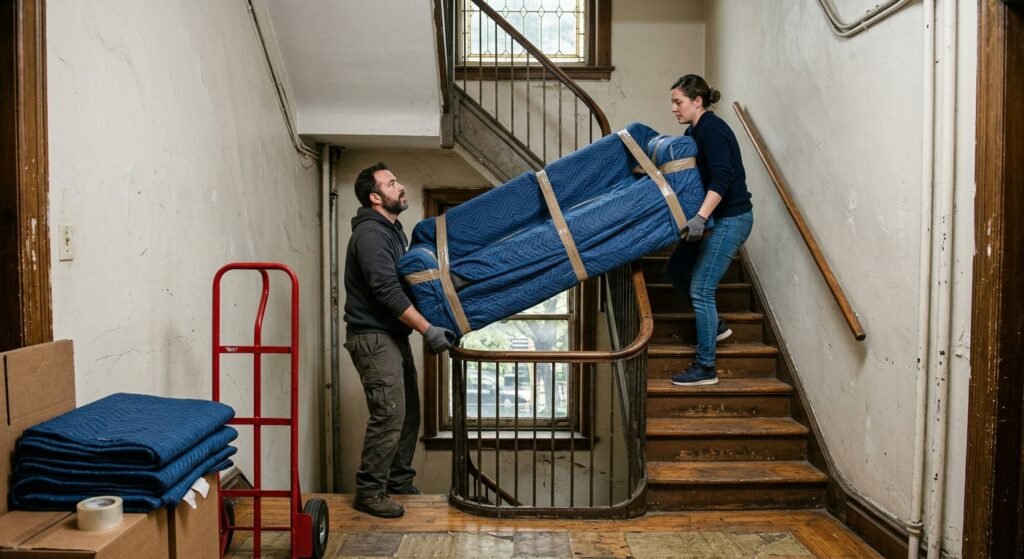
Most stairway disasters start the same way: someone grabs a couch on instinct, says “I’ve got it,” and takes the first step before anyone checks the angle, the railing, or the landing. Ten seconds later, the sofa is wedged, a knuckle is bleeding, and the wall has a new dent.
This guide is about avoiding that moment. Moving furniture up stairs or carrying furniture down stairs safely isn’t about brute strength; it’s about planning, geometry, and a few cheap tools that make a huge difference. If you’re deciding whether to muscle it yourself, recruit friends, or call pros, the details below will help you choose the safest way to move heavy items on stairs in your particular building.
Study the stairs before you touch the furniture
Before you even think about lifting, you need to know exactly what kind of staircase you’re working with. Ten minutes of scouting can save an hour of struggle and a trip to urgent care.
Walk the route from start to finish, empty-handed, and notice where your feet and hands go. Take photos if it helps. You’re looking for friction points: tight turns, low ceilings, loose carpet, and any place your grip or footing could fail.
Use the table below as a quick scan of stairway risks and what they actually mean in practice.
| Stair Feature | What to Look For | Impact on Moving Furniture Up Stairs |
|---|---|---|
| Width | Measure the narrowest point between wall and railing | Limits couch and mattress size; may require tilting “on edge” or disassembly |
| Ceiling height | Low bulkheads, sloped ceilings above steps | Tall items may not pivot around; risk of head impact and scraped ceilings |
| Landings | Size of each landing, direction of turns | Determines if large pieces can rotate; tight landings are the #1 jam point |
| Surface | Loose carpet, worn treads, wet or dusty areas | Affects traction; increases slip and trip risk under load |
| Railings | How sturdy, how far they protrude, removable or not | Can block wide items; removal sometimes creates crucial extra inches |
| Lighting | Burned-out bulbs, dark corners | Poor visibility makes missteps more likely, especially on descent |
As you assess, ask yourself two blunt questions:
- “If this slipped right here, where would it go?”
- “Can two people stand comfortably on each landing with the item between them?”
If you don’t like the answers, that’s a sign you need more people, different tools, partial disassembly, or possibly a different route altogether.
Measure furniture and map the path
Once you understand the staircase, you can decide what can actually travel up or down it in one piece. This is where a tape measure and a simple sketch are more valuable than optimism.
Measure these three things for every large item:
- Length, width, and depth of the furniture at its widest points.
- Diagonal length (corner-to-corner) if it’s a couch, dresser, or box spring.
- Removable parts (legs, arms, cushions, headboards) and how much size they shave off.
Then measure along the actual route:
- Doorway width and height at every doorway or gate.
- Stair width at the narrowest point.
- Landing depth and width, and the height to the ceiling on each landing.
It helps to put these numbers side-by-side. The idea is not just “will it fit at all” but “can it tilt, rotate, and clear the problem spots while two humans are holding it.”
| Measurement | Example Furniture | Minimum Clearance You Want | What It Tells You |
|---|---|---|---|
| Width vs. stair width | Sofa 36″ deep | At least 2–3″ of extra space | If sofa depth ≥ stair width, it may need to go up on its end or be disassembled |
| Diagonal vs. ceiling height at turns | Queen mattress diagonal | A few inches shorter than the clear vertical space | Predicts if a tall item can pivot around a 90° or 180° landing |
| Landing size vs. item length | Long dresser | Landing length ≥ dresser length | Determines if you can set it down safely to rest or change grip |
Sketch a basic floor plan of the stair run and mark any narrow doorways or ceiling overhangs. When you’re actually in the middle of moving heavy items on stairs, you won’t have the bandwidth to do mental geometry. Having a simple plan in advance makes your decisions calmer and safer.
People, roles, and safety gear
Stair moving is a team sport. Even experienced movers rarely carry large furniture on stairs solo, because the person below is controlling the weight and the person above is guiding and stabilizing.
For each significant piece, think through:
- How many lifters? Two is standard for most furniture. Three or four may be safer for very heavy or awkward items, especially going up.
- Who goes where? The stronger, more experienced person usually goes on the lower side where more weight is concentrated.
- Who’s spotting? A third person, if available, can spot from the side or at landings to adjust blankets, open doors, and guide around railings.
Agree on simple, unambiguous commands before you start:
- “Step” – take one stair.
- “Pause” – hold position, don’t move.
- “Back down” – reverse to the last safe step or landing.
- “Set down” – lower the item together.
Don’t improvise when you’re already tilted at a 45-degree angle; that’s how toes get crushed.
At a minimum, gather this safety gear:
- Work gloves with grip.
- Closed-toe, non-slip shoes or boots.
- Moving blankets or thick quilts.
- Stretch wrap or tape to secure drawers and doors.
- Optional but smart: back support belt and forearm lifting straps.
If anyone has a history of back, knee, or balance issues, be cautious about assigning them to the downhill position. There’s no shame in being the door-holder or the person who manages pads and tools; the real mistake is trying to be a hero and ending up injured.
Tools that make stair moves safer
Trying to move a loaded dresser upstairs with nothing but bare hands and a prayer is unnecessary punishment. A few rental or purchase items can drastically lower the risk and strain.
Here’s how common moving tools actually change the physics when you’re dealing with stairs.
| Tool | Best Use on Stairs | Pros | Limitations |
|---|---|---|---|
| Standard hand truck (dolly) | Short runs of wide, sturdy stairs with strong lifters | Keeps load vertical; good for boxes, small appliances | Awkward on narrow or carpeted stairs; can get away from you going down |
| Stair-climbing dolly | Heavy appliances on straight, solid staircases | Wheel design lets you “walk” up steps more smoothly | Still heavy; requires practice and a strong helper below |
| Forearm lifting straps | Couches, dressers, mattresses with two lifters | Shifts weight to legs; improves grip and control | Can be tricky in very tight turns or with short lifters |
| Shoulder dolly / harness | Very heavy but compact items like safes or armoires | Keeps hands freer; leverages body strength | Requires good communication and similar height partners |
| Slider pads / blankets | Transitions onto first or last step; resting on landings | Reduces friction; protects floors and furniture | Not safe as the sole support on the actual steps |
If you’re only doing one move, renting a stair-climbing dolly or shoulder harness for a day may make more sense than buying. On the other hand, forearm straps and gloves are inexpensive to own and can be used any time you rearrange heavy furniture, not just on moving day.
Techniques for moving furniture up stairs
Moving furniture up stairs is fundamentally different from moving it on flat ground. Gravity is pulling the piece back toward the lower person, and every step up increases the angle and the risk. Slow, synchronized movement is the rule.
1. Plan the direction and orientation before you lift
Decide which end of the item goes up first and who will be on which side:
- Heavier end down: On items like dressers or sofas, the heavier side should usually be on the lower person’s end so the weight doesn’t tip backward.
- Back or underside against the wall: This keeps visible surfaces away from scuffs and gives you more room to tilt.
- Test-tilt on flat ground: Before you hit the stairs, tip the item to the angle you expect to use and confirm both lifters can hold it steady.
2. Use the “step, pause, breathe” rhythm
Instead of trying to power up an entire flight in one go, move in a predictable pattern:
- Lower lifter calls, “Step.”
- Both climbers take one stair in unison.
- Once steady, lower lifter says, “Pause,” and both reset their grip.
- Repeat. Rest on a landing if needed.
This pattern reduces surprise shifts in weight and helps avoid the panicky “keep going, we’re almost there” rush that leads to mistakes.
3. Keep the item low but tipped, not vertical
For most furniture, you don’t want it perfectly vertical. A slight tip toward the stairs helps keep the center of gravity over the steps instead of hovering out over the lower person.
Example (hypothetical): You’re carrying a 7-foot couch upstairs. Instead of keeping it horizontal, you stand it on one end, tip it about 20–30 degrees toward the stairs, and the lower person supports the majority of the weight while the upper person guides. That tilt lets the long side clear tighter staircases without the top slamming into the ceiling.
4. Never push from below without someone stabilizing above
If you’re tempted to “just push it up” from the bottom, stop. Without someone above stabilizing and guiding, a heavy object can roll back or twist sideways, trapping your hands or feet. Both positions need real control, not just power.
5. Rest smart on landings
When you reach a landing, resist the urge to collapse. Set the item down in a way that preserves your progress:
- Lay tall items flat on their side if there’s room.
- If space is tight, rest one end on a moving blanket against the wall and block wheels if it’s on a dolly.
- Plan where your feet will go when you lift again so you’re not immediately boxed in.
How to carry furniture down stairs without losing control
Carrying furniture down stairs is often more dangerous than going up because gravity is working with the furniture, not with you. The lower person must be prepared for shifting weight, and you need clear escape options if something starts to slide.
1. Clear the path and decide escape zones
Before moving heavy items downstairs, make sure:
- The entire stairway and downstairs landing are free of boxes, shoes, and pets.
- Doors at the bottom are propped open.
- You’ve talked through where the lower person can safely step aside if the piece gets away.
2. Lower person leads and sets the pace
Going down, the person below has the hardest job and should control the timing:
- They call each “Step” when they’re stable and ready.
- They ask for “Pause” or “Back up” if they feel the load shifting or their footing isn’t secure.
- They should be comfortable saying “Set down” immediately if things feel unsafe.
3. Keep the weight as close to your body as possible
When carrying furniture down stairs, your instinct might be to hold the piece away from your body so you can see your feet better. That actually strains your back and makes it easier for the item to pull you forward.
Instead, keep the load close to your center of gravity. Accept that the lower person might not see every step perfectly and should go very slowly, feeling for each tread with their heel.
4. Never slide heavy furniture down bare stairs
It might seem clever: put a blanket under the item and slide it down like a sled. In reality, this can turn into a runaway toboggan that no one can stop, destroying walls and potentially hitting someone at the bottom.
If you absolutely must lower something by sliding (for example, a relatively light but bulky item and no one strong enough to carry it), you should:
- Have one person below with a rope or strap wrapped securely around the piece, acting as a brake.
- Have another person above guiding and keeping it from twisting.
- Move a few inches at a time, not full steps.
Even then, it’s a backup strategy, not the preferred method.
Item-by-item stair moving tips
Not every piece of furniture behaves the same way on stairs. A couch, a dresser, and a washing machine all have different balance points, handholds, and damage risks. Adjust your approach based on what you’re actually moving.
Couches and sectional sofas
- Disassemble as much as possible: Remove legs, detachable arms, and cushions. Separate sectionals into individual pieces.
- Use the “hook” method on tight turns: On a 90-degree landing, stand the couch on one end and “hook” it around the corner: rotate the top into the new direction while the bottom stays near the corner, then swing the bottom around.
- Protect corners: Wrap thick blankets around the arms and corners, securing with tape or stretch wrap so they don’t slide off mid-move.
Mattresses and box springs
- Use mattress bags with handles if you can; they add grip and protect fabric.
- Flex when allowed: Some foam or hybrid mattresses can be carefully bent around tight corners; many traditional box springs cannot.
- Stand on edge for narrow stairs: It’s often easiest to carry a mattress on its long edge with each person gripping top and bottom.
Dressers and chests
- Empty drawers to cut weight and prevent shifting contents from throwing off your balance.
- Secure drawers with stretch wrap or painter’s tape (gentle on finishes) so they don’t slide open.
- Tilt slightly back toward the upper person to keep the dresser from overloading the person below.
Appliances (washer, dryer, fridge)
- Use a sturdy appliance dolly with straps if at all possible.
- Drain and disconnect completely (water, gas, power) before moving.
- Keep upright unless the manufacturer explicitly says otherwise, especially for refrigerators.
- Consider hiring pros for very heavy appliances that must travel multiple flights; the injury risk is high.
Beds and frames
- Break down frames fully into rails, slats, and headboard/footboard.
- Carry headboards vertically and pad decorative surfaces.
- Watch for tall posts that can catch on low ceilings at landings.
| Item Type | Recommended People | Key Prep Step | Typical Risk on Stairs |
|---|---|---|---|
| Standard sofa | 2 | Remove legs and cushions; wrap arms | Jamming at turns; scuffing walls |
| Queen mattress | 2 | Bag with handles; carry on edge | Bending too far; blocking view of steps |
| Tall dresser | 2–3 | Empty and secure drawers | Top-heavy tipping; drawer slide-outs |
| Washing machine | 2–3 with appliance dolly | Drain hoses and secure drum (if required) | Sheer weight; potential back injury |
Dealing with tight, spiral, or exterior stairs
Some staircases are simply not furniture-friendly. Older city walk-ups, spiral stairs, and steep exterior steps add a layer of difficulty that changes how you plan the move.
Narrow or enclosed stairwells
For very narrow interior stairs:
- Maximize disassembly: Take apart bed frames, remove sofa backs/arms when possible, take tabletops off bases.
- Use protective wrapping as padding, not bulk: Avoid adding unnecessary inches; keep blankets tight and tape them securely.
- Consider hoisting alternatives: If a key item truly won’t fit, you may need a hoist through a large window or balcony, which usually requires professional help and sometimes special permits.
Spiral staircases
Spiral stairs can be deceptively tricky. Their central pole and tight turns often block long or stiff pieces.
- Measure the clear space between the central pole and outside rail carefully.
- Expect to rotate items continuously as you move, not just at landings.
- If something doesn’t clearly fit while you’re still on flat ground, don’t start up the spiral “to see what happens.” Backing down with an awkward piece is much harder than not starting at all.
Exterior steps and stoops
Outdoor stairs add weather, uneven risers, and sometimes no railings:
- Check traction: Wet, icy, or mossy steps can make any heavy-item move a bad idea. It may be worth delaying a day if conditions are poor.
- Use extra spotters: Someone can stand off to the side to help stabilize and warn about edges.
- Watch for height differences: Uneven step heights can throw off rhythm and balance; go slower and call each step out loud.
| Stair Type | Main Challenge | Typical Adjustment | When DIY Becomes Risky |
|---|---|---|---|
| Narrow interior | Limited width and ceiling height | Disassemble, tilt on edge, use thin padding | When core items cannot clear landings even on edge |
| Spiral | Tight turns around center post | Favor smaller components or alternative routes | When long, rigid pieces must go up multiple rotations |
| Exterior concrete | Slippery when wet; no interior wall to brace | Extra spotter; choose dry conditions | During rain, snow, or with very heavy appliances |
Protecting walls, railings, and floors
Even if nobody gets hurt, a gouged banister or a crushed stair nose can be expensive to fix, especially in rentals or shared buildings. Protecting the staircase is part of moving furniture up stairs responsibly.
Quick protection checklist
- Walls and corners: Tape moving blankets or flattened cardboard to high-risk areas, especially at turns and narrow doorways.
- Railings: Wrap towels or blankets around railings where furniture might rub, and secure with tape or zip ties (being careful not to damage the finish).
- Floors and stair treads: Use non-slip runners or rosin paper plus painter’s tape on wood floors at the top and bottom of the stairs. Don’t create tripping hazards with loose coverings.
- Door hardware: Remove or cover protruding knobs, latches, and window cranks that could snag fabric.
Take photos of the stairwell condition before you start if you’re in a rental or condo. That way, if a scuff was already there, you can show that it wasn’t caused during your move.
When to call professional movers for stair work
Sometimes the honest answer is that you shouldn’t be the one moving certain items up or down stairs. Recognizing that early can prevent injuries and expensive damage.
You should strongly consider hiring movers when:
- The item is heavier than any one person on your team can safely lift, even briefly.
- Stairs are steep, narrow, or poorly lit, and you can’t improve those conditions.
- There are multiple flights and you have several heavy pieces to move.
- You’re dealing with high-value items like antiques, large TVs, or specialty equipment where a mistake would be financially painful.
- Building rules require proof of insurance or professional movers for moves.
When you talk with moving companies, be specific about the stair situation. Mention:
- Number of steps and flights.
- Any tight turns or low ceilings.
- Largest items that must go up or down.
- Whether there’s elevator access for part of the route.
That detail helps them decide how many crew members to send and what equipment they’ll need, and it helps you get a more accurate estimate. If you want to compare stair-moving options from different companies, a comparison site like Moving US Van Lines can give you a sense of which movers focus on walk-up buildings versus elevator moves or single-family homes.
Common stair moving mistakes to avoid
Often, avoiding a few classic mistakes matters more than executing perfect technique. Here are pitfalls that cause problems again and again.
- Underestimating weight: That “not so bad” dresser can feel twice as heavy halfway up a staircase. If you’re unsure, treat it as heavy and gear up accordingly.
- Skipping disassembly: Leaving sofa legs or bed frames installed because “it’s only a few inches” is how you end up stuck on a landing.
- Wearing bad footwear: Flip-flops, socks, or heels on stairs with weight in your hands is asking for a fall.
- Overloading a single trip: Carrying boxes stacked so high you can’t see your feet turns stairs into a guessing game. Make more trips with smaller loads.
- Rushing because of time pressure: Trying to beat a truck rental deadline by speeding down stairs with heavy furniture is a poor trade-off.
- Ignoring fatigue: As soon as someone’s legs start to shake, reaction time drops. Take real breaks rather than pushing through.
| Mistake | Short-Term Consequence | Long-Term Impact | Better Choice |
|---|---|---|---|
| Lifting too much weight | Back strain, dropped item | Lingering injuries, medical bills | Add a helper or hire movers for the heaviest pieces |
| Skipping measurements | Item wedged mid-stair | Wall repairs, possible railing damage | Measure item and stairs; disassemble when close |
| Improvised commands | Missteps, out-of-sync lifting | Higher accident risk on future moves | Agree on simple, standard cues before starting |
| No padding on walls | Visible scrapes and dings | Loss of security deposit; repair time | Use blankets or cardboard at key contact points |
Where to verify safety and building rules
Rules and responsibilities around stair moves can vary by building and location. Before moving heavy items on shared stairs:
- Check your lease or condo bylaws for move-in/move-out procedures, elevator restrictions, and required proof of insurance for movers.
- Ask building management if there are designated move times or stairwell protection requirements.
- Review manufacturer instructions for appliances or specialty items to see recommended moving positions and any warnings about tilting.
If professional movers will be handling the stair work, clarify how their valuation coverage works and what’s covered if walls, railings, or the furniture itself are damaged during the move. Policies differ, especially between interstate and local moves.
FAQ: Moving furniture up and down stairs
How many people should help move a couch up stairs?
For an average-size couch, two capable adults are usually the minimum: one above to guide and one below to take most of the weight. Add a third person as a spotter if the stairs are narrow, the couch is extra heavy, or there are tight landings. If the piece feels borderline even for two people, it’s a sign you may need pros.
Is it safe to carry furniture down stairs by myself?
Carrying large furniture down stairs solo is generally not safe. Going down concentrates weight on the lower end, and if the item shifts, there’s no one to help control it. Solo trips should be limited to small, manageable boxes you can carry with one hand on the railing. For bulky or heavy items, at least one partner is strongly recommended.
What’s the safest way to move a mattress up a narrow staircase?
The safest approach is to put the mattress in a protective bag with handles, carry it on its long edge, and have one person at each end. Tilt it slightly so the top clears any low ceilings or railings. Move one step at a time, pausing frequently to adjust your grip. If the mattress can bend safely, a gentle flex around tight corners can help, but avoid sharply folding anything with springs.
Can I use a regular dolly on stairs?
A standard hand truck can work on short, sturdy staircases for certain items, but it’s not ideal. The lower person must control both the weight and the dolly, and the wheels can slip on carpeted or uneven steps. For frequent or heavy stair moves, a stair-climbing dolly with rotating wheels is safer. Large furniture like couches usually shouldn’t go on a regular dolly on stairs at all.
How do I protect my walls and railings while moving furniture upstairs?
Pad every spot you expect contact: tape moving blankets or cardboard to corners and along tight sections of wall, and wrap railings with towels or blankets secured with tape or zip ties. Remove or cover door hardware that might snag fabric. Keep padding snug so it doesn’t shift and become a tripping hazard.
When should I hire professional movers instead of doing the stairs myself?
Consider hiring movers when items are too heavy for your group to comfortably lift, when there are multiple steep flights, or when tight turns and low ceilings make the route complex. It’s also smart to use pros for high-value pieces, large appliances, or when your building requires insured movers. The cost is often less than medical bills or major repair work.
Is sliding furniture down the stairs on a blanket a good idea?
Sliding furniture down stairs on a blanket is risky. Once the piece starts moving, it can pick up speed faster than you can control, damaging walls and potentially injuring people at the bottom. If you ever resort to sliding, use a rope or strap controlled from below as a brake, and move only a few inches at a time. In most cases, carrying with proper technique is safer.
How do I move heavy items on stairs without hurting my back?
Protect your back by keeping the load close to your body, bending at your knees and hips rather than your waist, and lifting with your legs. Use tools like forearm straps, dollies, or shoulder harnesses to share the load. Take frequent breaks, and stop immediately if you feel sharp pain. If an item feels too heavy even with good technique, don’t force it—add helpers or hire professionals.
If, after walking your staircase and sizing up your furniture, you’re still unsure what’s realistic to handle yourself, get a few opinions and quotes. Comparing options through a service like Moving US Van Lines can help you decide which pieces you want pros to handle on the stairs and which you’re comfortable carrying with a careful DIY plan.
Relocation writer covering city guides and neighborhood moving tips.
More from the blog
Compare movers by service
Where to find us
Compare quotes from licensed movers
Submit your move details once and receive custom quotes — all at no cost.